Two new technologies tha could transform diabetes management?
October 2026 could prove to be a memorable month for diabetics looking for better ways to manage their blood glucose levels. Two new scientific studies caught my eye. The first, from a group at the University of Cambridge (UK), involves the use of some novel light technology to measure blood glucose without having to pierce the skin. The second, from the Eidgenössische Technische Hochschule (ETH) Zürich (Switzerland), uses an electrical current through an implant to lower blood sugar and promote weight loss. Both are potentially significant developments and I’d love to see the two working together in the future.
From the University of Cambridge
Current methods of measuring blood glucose involve finger pricking, for handheld glucose monitors. or the insertion of a needle like probe, for continuous glucose monitors. Companies like Apple and Google, have
spent years and many millions on trying to develop watch type technology to monitor glucose but, so far, haven’t managed to succeed. They both are using light (near infra-red) but have seemingly struggled to achieve reliable results.
The Cambridge group are using a near infra-red source but what is described as “the convolution theorem as its unique mathematical foundation”. At this point I have to confess that the science is beyond me but the results are impressive, worthy of publication in Nature Photonics (a top science journal). The prototype device developed has watch like dimensions and besides glucose could measure other blood markers of interest such as lactate and alcohol! The other benefit looks to be the cost. The prototype does not cost much, probably a tenth of the
price of a CGM device. However, costs will undoubtedly rise with regulatory controls, linked app developemnts and
software customisation. The outcome may well be les expensive but undoubtedly more than the initial hype.
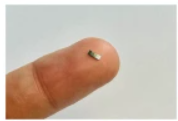
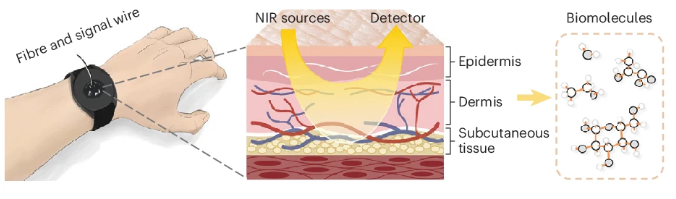
The images below, taken from the publication, show the small sixe of the photonic chip and a cartoon of how the device works.
Reference
Yao, C., Ma, J., Wang, N. et al. Optical convolutional spectrometer. Nat. Photon. 20, 664–672 (2026). https://doi.org/10.1038/s41566-026-01891-6
From the ETH Zurich
Measuring blood glucose levels is hugely important in diabetes management but so is controlling those levels. Whilst diet and exercise can really help, most type 2 diabetics will be prescribed metformin, sulfonyl ureas or insulin. Type 1 diabetics rely on regular insulin injections. But who wants to pop pills or sick needles in themselves for the rest of their lives? The Zurich group describe the development and testing of an “implantable electrocatalyst that directly removes excess glucose from the bloodstream”.
The implantable device contains platinum and gold nanoclusters embedded in graphite. This can be wirelessly powered to selectively oxidise glucose into gluconate, which is readily removed from the body in urine. Coupling the device with a continuous glucose monitor allows activation only when required prevents overactivation which could lead to hypoglaemic issues. Interestingly the results, in mice, also showed that lowering glucose also shifted metabolism to use of stored fat. So, the mice lost weight too.
The image below shows how the device would work either linked to a CGM with automated control or via manual control.
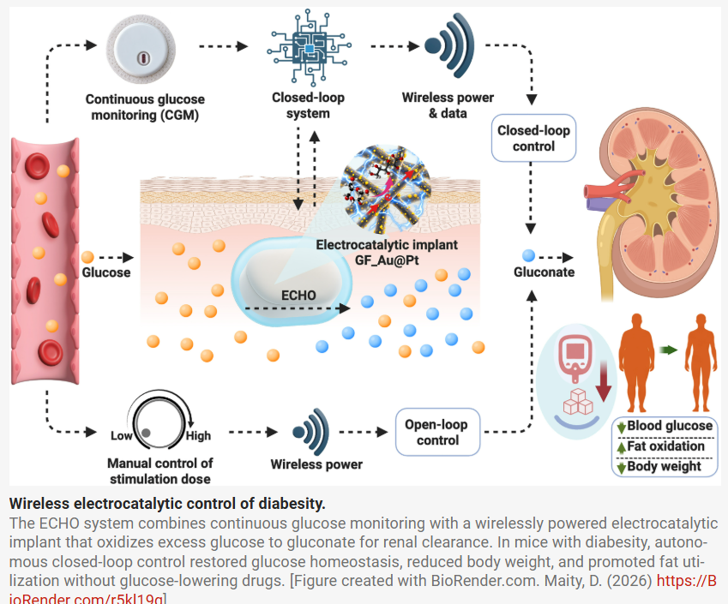
Again, this exciting research comes with some caveats. The results show excellent glucose control in diabetic mice over a 6 week period. The schematic above, taking from the original journal article, shows a human figure losing weight. This is a big leap from the actual data in a few lab mice. We need to see some longer-term human trials to see if this potential is realised and we all rush out to get our implants. This is another technology I will be following up on in future blogs.
Reference
Maity D, Ray P G, Buchmann P, Charpin-El Hamri G, Fussenegger M. Wireless electrocatalytic closed-loop system for drug-free management of diabesity. Science, 2026; 394 (6822) DOI: 10.1126/science.ady8560a
Closing thoughts
Science has, and will continue, to change the way we view and deal with diabetes. It is not that long ago that diabetes was seen as a death sentence. Now its mostly manageable in its various forms through exercise, diet and pharmaceuticals. Who knows what our experience of diabetes will be like twenty years from now.
Whilst I have referenced the actual science publications above, I would also like to acknowledge the online journal ScienceDaily which was the original source of both these stories for me. You can read their take on this research at:-
University of Cambridge. “Cambridge scientists create a $10 chip that could put a medical lab on your wrist.” ScienceDaily. ScienceDaily, 22 October 2026. <www.sciencedaily.com/releases/2026/10/261022081312.htm>.
ETH Zurich. “New diabetes implant uses electricity to lower blood sugar and promote weight loss.” ScienceDaily. ScienceDaily, 2 November 2026. <www.sciencedaily.com/releases/2026/10/261031221151.htm>.